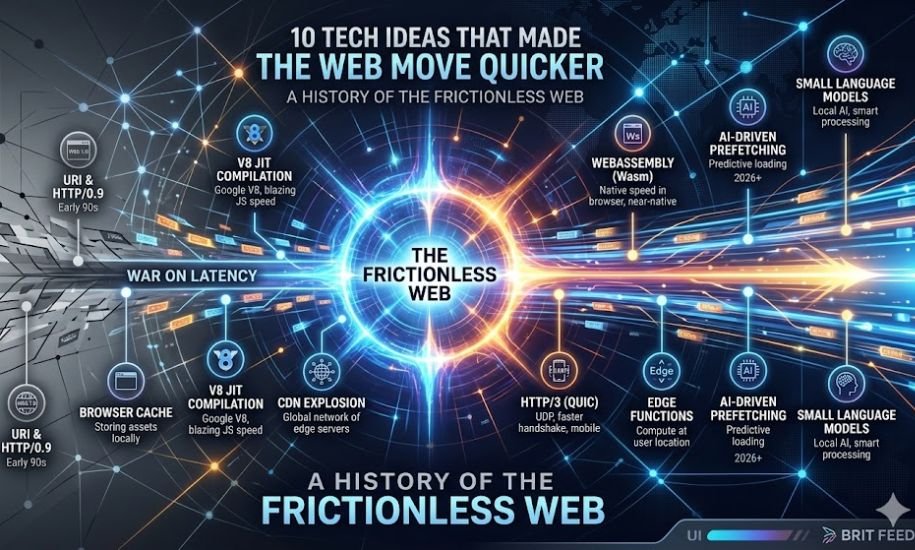

In the early 1990s, clicking a link was an act of faith. You’d click, walk away to make a cup of coffee, and hope that by the time you returned, a grainy image of a teapot had finished its agonizing descent onto your screen.
Today, we expect 4K video to stream instantly on a moving train. This transition didn’t happen by accident. It was the result of a “War on Latency”—a series of radical tech ideas that made the web move quicker by systematically dismantling the barriers between a user’s intent and a server’s response.
To understand where the web is going in 2026, we have to look at the “Frictionless Web”—the innovations that turned a static library into a real-time global brain.
The Dawn of Velocity (1990–2005): Breaking the Silence
The first era of web speed wasn’t about “fast” so much as it was about “functional.” But even then, visionaries knew that if the web stayed slow, it would remain a niche academic tool.
1. The Browser Cache: The Fastest Request is the One You Never Make
In the mid-90s, the brightest minds realized the best way to speed up the web was to stop using it. By storing static assets (images, logos, CSS) locally on a user’s hard drive, the Browser Cache eliminated the need to re-download the same files on every page load. It was the first true “speed hack,” and it remains the foundation of performance today.
2. The JIT Revolution: Turning JavaScript into a Powerhouse
For nearly two decades, JavaScript was the “toy” language of the web—slow, interpreted, and prone to freezing browsers. That changed in 2008 with Google’s V8 Engine.
Named after the powerful car engine, V8 introduced Just-In-Time (JIT) compilation. Instead of interpreting code line-by-line, V8 compiled JavaScript directly into machine code. Suddenly, complex applications like Google Maps and Gmail were possible. As of 2026, V8’s evolution—through compilers like Maglev and Sparkplug—has made the browser nearly as fast as native desktop software.
Architecting the Modern Highway (2006–2018): Reducing the Distance
As the web grew, we hit a physical wall: the speed of light. Data can only travel so fast across an ocean. The next wave of tech ideas that made the web move quicker focused on shortening the physical and logical distance between data and the user.
3. The CDN Explosion: Moving to the User’s Doorstep
Content Delivery Networks (CDNs) like Akamai and later Cloudflare changed the geography of the internet. By placing “edge servers” in almost every major city, CDNs ensured that when a user in London requested a site hosted in California, the data only had to travel a few miles to a local data center. This eliminated hundreds of milliseconds of RTT (Round-trip Time).
4. Resource Multiplexing (HTTP/2)
Before 2015, browsers were stuck in a “bottleneck.” They could only request a few files at a time from a server. If one large image got stuck, everything behind it waited—a nightmare known as Head-of-Line Blocking.
HTTP/2 solved this with multiplexing, allowing the browser to “spray” multiple requests over a single connection simultaneously. It was like upgrading from a one-lane country road to a ten-lane superhighway.
The Zero-Latency Era (2019–2026): Rewriting the Rules
We are currently in the most exciting phase of web performance. We are no longer just “optimizing” the old web; we are rewriting its fundamental protocols.
5. QUIC & HTTP/3: The End of the Handshake
Every time you connect to a website, your computer and the server perform a “handshake” to ensure the connection is secure. In the old days (TCP), this took multiple trips back and forth.
HTTP/3, built on the QUIC protocol, combines the connection and encryption handshakes into one. It also handles “packet loss” much better. If you go through a tunnel and lose a tiny bit of data, HTTP/3 doesn’t stop the whole page—it just fixes the missing piece and keeps moving.
6. WebAssembly (Wasm): Near-Native Performance in a Tab
WebAssembly is perhaps the most underrated tech idea on this list. It allows developers to run high-performance code (written in C++ or Rust) inside the browser.
- Real-world insight: This is why you can now edit heavy video files in Adobe Premiere Rush or design complex 3D models in Figma directly in a Chrome tab without your computer sounding like a jet engine.
7. Edge Functions: Logic at the Speed of Light
The old way: Your phone asks a server in Virginia to calculate a price, and the server sends it back.
The Edge way: The calculation happens on a server 10 miles away from you. By moving “logic” (not just images) to the edge, we’ve effectively killed the “loading spinner” for modern web apps.
Beyond 2026: The Predictive Web
As an SEO strategist looking at the data for 2026, the next frontier isn’t just “fast”—it’s Predictive.
8. AI-Driven Prefetching
We are entering an era where AI Agents at the edge analyze your behavior in real-time. If the AI determines there is an 85% chance you will click the “Checkout” button, it begins loading that page’s assets in the background before you even move your mouse. This turns “instant” into “anticipatory.”
9. Small Language Models (SLMs) at the Edge
While massive AI like GPT-4 lives in the cloud, 2026 is the year of the SLM. These are tiny, specialized AI models that live in your browser or a nearby edge node. They can process voice commands, translate text, or optimize images locally, removing the need to wait for a round-trip to a massive data center.
Summary of Key Technologies
| Technology | The “Friction” It Solved | Key Benefit |
| Browser Cache | Redundant downloads | Instant repeat visits |
| V8 Engine | Slow JavaScript execution | Enabled complex Web Apps |
| CDNs | Physical distance (Latency) | Global 100ms response times |
| HTTP/3 (QUIC) | Connection “Handshake” lag | Better performance on mobile/unstable networks |
| WebAssembly | Browser CPU limitations | Native-speed apps in the browser |
FAQs: Tech Ideas and Web Speed
What is the most important factor for web speed in 2026?
While protocols like HTTP/3 are vital, Core Web Vitals (specifically LCP and CLS) remain the gold standard. However, “Time to First Byte” (TTFB) is becoming more critical as logic moves to the Edge.
Does a faster website actually help SEO?
Yes, absolutely. Since 2021, Google has used “Page Experience” as a ranking factor. A 1-second delay in mobile load times can decrease conversion rates by up to 20%.
Is JavaScript still the reason websites are slow?
It can be. While engines like V8 are fast, “bloated” JavaScript (too many third-party scripts) still causes “Main Thread Blocking,” which makes pages feel sluggish even if they’ve technically “loaded.”
Conclusion: The Race Never Ends
The history of tech ideas that made the web move quicker is a testament to human impatience. We refused to wait for images, so we built the cache. We refused to wait for code, so we built V8. We refused to wait for the speed of light, so we built the Edge.
As we move deeper into 2026, the “Frictionless Web” will become invisible. We won’t talk about “loading” anymore; we will only talk about “experiencing.” For developers and creators, the challenge is no longer just about minifying CSS—it’s about leveraging Edge AI and Wasm to create experiences that feel as immediate as thought.
Stay ahead of these shifts and keep your digital presence optimized. For more deep dives into the pulse of the digital world, keep your eyes on Brit Feed.
Is your site ready for the HTTP/3 era? Audit your speed today and don’t let latency kill your rankings.