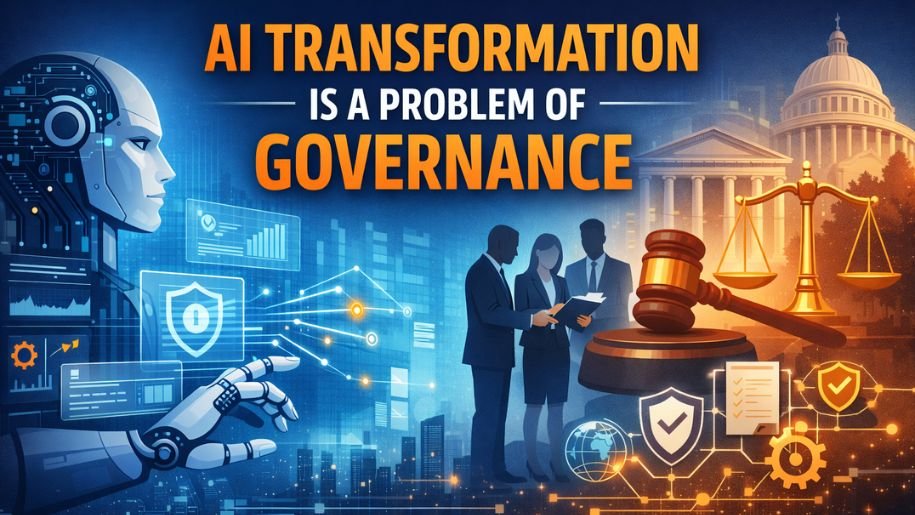

Artificial Intelligence is rapidly transforming industries, economies, and societies. Businesses across the world are investing billions of dollars in AI technologies in hopes of increasing efficiency, improving decision-making, and creating new business opportunities. However, despite the excitement and heavy investment surrounding artificial intelligence, many organizations struggle to achieve meaningful results from their AI initiatives. Projects remain stuck in pilot stages, models fail to scale, and expected business value often never materializes.
One of the most important reasons behind this gap between AI potential and real-world impact is governance. While many leaders focus on acquiring advanced algorithms, hiring data scientists, or building large data infrastructures, they often overlook the governance structures required to manage AI systems effectively. AI transformation is not simply a technological upgrade; it is a fundamental organizational shift that requires strong leadership, clear accountability, ethical oversight, and well-defined decision-making frameworks.
In essence, the biggest challenge in AI transformation is not technology itself but governance. Without proper governance, organizations cannot coordinate AI initiatives, manage risks, ensure ethical use, or integrate AI into long-term strategic goals.
Understanding AI Transformation
AI transformation refers to the process through which organizations integrate artificial intelligence into their core operations, decision-making processes, and strategic planning. Unlike small technological improvements, AI transformation reshapes how companies operate, compete, and innovate.
Traditional digital transformation focused mainly on digitizing processes and improving information systems. AI transformation goes further by enabling machines to analyze data, identify patterns, make predictions, and sometimes even make decisions autonomously.
For example, AI systems can analyze customer behavior to predict purchasing patterns, optimize supply chains, detect fraud, automate customer support, and support complex medical diagnoses. These capabilities have the potential to dramatically improve productivity and efficiency across industries.
However, implementing AI successfully requires more than simply deploying models or collecting data. AI systems must be integrated into existing workflows, monitored for reliability, aligned with organizational objectives, and governed to prevent misuse. Without these elements, AI systems may create confusion, inefficiencies, and even serious risks.
Why Technology Alone Is Not Enough
Many organizations initially treat AI transformation as a purely technical problem. They assume that by investing in the latest machine learning tools, hiring skilled engineers, and building large datasets, they will automatically unlock AI’s potential.
In reality, technology is only one piece of the puzzle.
AI systems operate within complex organizational environments that involve people, policies, processes, and strategic goals. Without proper governance, even the most advanced AI systems may fail to deliver value. Teams may build models that are never deployed, departments may develop competing systems that cannot communicate with each other, and leaders may struggle to understand how AI decisions are being made.
Furthermore, AI systems introduce new risks that traditional governance structures are often not prepared to handle. These include algorithmic bias, lack of transparency, ethical concerns, and regulatory challenges. Without governance mechanisms to manage these risks, organizations may face reputational damage, legal issues, or loss of public trust.
Thus, the real challenge of AI transformation lies in creating governance frameworks that guide how AI is developed, deployed, and managed.
The Role of Governance in AI Transformation
Governance refers to the systems, policies, and leadership structures that guide how decisions are made and how organizations ensure accountability. In the context of artificial intelligence, governance determines how AI technologies are aligned with business objectives, ethical principles, and regulatory requirements.
Effective AI governance ensures that AI initiatives are coordinated across the organization rather than being isolated experiments conducted by individual teams. It establishes clear responsibilities for who owns AI systems, who monitors their performance, and who is accountable for their outcomes.
Governance also helps organizations manage the risks associated with AI. Because AI systems often make predictions or recommendations based on complex algorithms, it can be difficult for leaders to understand how decisions are being made. Governance frameworks introduce processes for auditing models, evaluating fairness, and ensuring transparency.
Additionally, governance ensures that AI systems are aligned with long-term strategic goals. Instead of developing AI solutions purely for experimentation, organizations can prioritize projects that deliver measurable value and support broader business objectives.
Leadership and Accountability in AI Initiatives
One of the most common governance challenges in AI transformation is the lack of clear leadership. AI projects often begin within individual departments such as marketing, finance, or operations. While these initiatives may generate useful insights, they often remain isolated from the broader organization.
Without centralized leadership, organizations struggle to coordinate AI efforts, allocate resources effectively, and maintain consistent standards. Different teams may use different data sources, develop incompatible models, or pursue conflicting goals.
Strong leadership is therefore essential for successful AI governance. Senior executives and boards must actively oversee AI initiatives, ensuring that they align with organizational strategy and deliver real business value. Leaders must also ensure that the organization has the necessary skills, policies, and infrastructure to manage AI responsibly.
Accountability is another critical component. Organizations must clearly define who is responsible for AI outcomes. If an AI system makes an incorrect prediction or produces biased results, someone must be accountable for addressing the issue. Without accountability, AI systems may operate without adequate oversight, increasing the risk of harmful outcomes.
Data Governance as the Foundation of AI
Artificial intelligence relies heavily on data. Machine learning models learn patterns from historical data and use those patterns to make predictions or decisions. If the data used to train AI systems is inaccurate, incomplete, or biased, the resulting models will produce unreliable results.
This makes data governance a fundamental part of AI governance. Organizations must establish policies for how data is collected, stored, processed, and shared. They must ensure that data is accurate, secure, and ethically sourced.
Data governance also involves defining who has access to data and how it can be used. Without proper controls, sensitive information may be misused or exposed, leading to privacy violations and regulatory penalties.
By establishing clear data governance practices, organizations can ensure that their AI systems are built on reliable and trustworthy information.
Ethical Challenges in AI Transformation
Artificial intelligence raises significant ethical questions that traditional governance systems may not be equipped to address. Because AI systems can influence hiring decisions, financial approvals, healthcare recommendations, and many other aspects of daily life, they have the potential to affect people in profound ways.
One major ethical concern is algorithmic bias. If AI systems are trained on biased data, they may produce discriminatory outcomes. For example, an AI hiring system trained on historical hiring data may unintentionally favor certain demographic groups over others.
Transparency is another ethical challenge. Many AI models, particularly deep learning systems, operate as “black boxes” whose internal decision-making processes are difficult to understand. This lack of transparency can make it difficult for organizations to explain or justify AI decisions.
Ethical governance frameworks help address these challenges by establishing principles for fairness, transparency, and accountability. Organizations may create ethics committees, implement bias detection tools, and require human oversight for critical decisions.
By embedding ethical considerations into governance structures, organizations can ensure that AI technologies are used responsibly and in ways that benefit society.
Regulatory and Legal Considerations
As artificial intelligence becomes more widespread, governments and regulatory bodies are introducing laws and guidelines to manage its use. These regulations aim to protect individuals from potential harms associated with AI while promoting innovation and economic growth.
Organizations implementing AI must therefore navigate a complex and evolving regulatory landscape. This includes ensuring compliance with data protection laws, privacy regulations, and emerging AI-specific legislation.
Governance frameworks help organizations stay compliant by establishing processes for monitoring regulatory changes, assessing legal risks, and implementing appropriate safeguards. Without these structures, companies may inadvertently violate regulations and face significant legal consequences.
The Importance of Organizational Culture
AI transformation is not only about systems and policies; it also requires a shift in organizational culture. Employees must learn how to work alongside AI systems, interpret AI insights, and make decisions based on data-driven recommendations.
Governance plays an important role in shaping this cultural shift. Leaders must promote transparency, encourage collaboration between technical and non-technical teams, and ensure that employees understand the role of AI within the organization.
Training and education are essential components of this process. Employees at all levels must develop a basic understanding of AI capabilities and limitations. This helps prevent unrealistic expectations and encourages responsible use of AI technologies.
When governance structures support learning and collaboration, organizations can build a culture that embraces AI innovation while maintaining accountability and ethical responsibility.
Scaling AI Across the Organization
Many organizations successfully develop AI prototypes but struggle to scale them across the enterprise. This challenge often arises from weak governance structures that fail to coordinate AI initiatives across departments.
Scaling AI requires standardized processes, shared infrastructure, and clear governance mechanisms. Organizations must establish guidelines for model development, validation, deployment, and monitoring.
Governance frameworks also help organizations measure the impact of AI initiatives. By defining clear performance metrics and evaluation processes, leaders can determine whether AI projects are delivering the expected value.
Through effective governance, organizations can move beyond isolated experiments and integrate AI into core operations.
Building Effective AI Governance Frameworks
To address the governance challenges associated with AI transformation, organizations must develop comprehensive governance frameworks. These frameworks typically include leadership oversight, data governance policies, ethical guidelines, risk management processes, and compliance mechanisms.
Successful governance frameworks are flexible and adaptable, allowing organizations to respond to new technological developments and regulatory changes. They also involve collaboration across multiple stakeholders, including executives, technical experts, legal advisors, and ethicists.
Ultimately, effective AI governance enables organizations to harness the power of artificial intelligence while minimizing risks and ensuring responsible use.
Conclusion
Artificial intelligence has the potential to revolutionize industries, improve productivity, and solve complex global challenges. However, the success of AI transformation depends not only on technological innovation but also on governance.
Without strong governance structures, organizations may struggle to coordinate AI initiatives, manage risks, ensure ethical practices, and align AI systems with strategic goals. Technology alone cannot deliver transformation; it must be guided by clear leadership, accountability, and responsible decision-making.
By recognizing that AI transformation is fundamentally a governance challenge, organizations can focus on building the policies, structures, and cultural foundations needed to support successful AI adoption. When governance is prioritized alongside technological development, artificial intelligence can become a powerful tool for innovation, efficiency, and positive societal impact.
Frequently Asked Questions
Why AI Transformation is a problem of governance?
AI Transformation is a problem of governance because successful implementation requires leadership, accountability, ethical oversight, and risk management. Without these governance structures, AI initiatives often fail to scale or deliver value.
What is AI governance?
AI governance refers to the policies, processes, and organizational structures used to oversee the development, deployment, and monitoring of artificial intelligence systems to ensure they are safe, ethical, and aligned with strategic goals.
What risks arise from poor AI governance?
Poor AI governance can lead to biased algorithms, privacy violations, regulatory penalties, unreliable decision-making systems, and loss of trust from customers and stakeholders.
How does governance help organizations scale AI?
Governance provides standardized processes, clear leadership, and coordinated strategies that allow AI systems to be integrated across departments and scaled effectively within the organization.
What role does leadership play in AI governance?
Leadership ensures that AI initiatives align with organizational goals, resources are allocated effectively, risks are managed properly, and ethical guidelines are followed throughout the AI lifecycle.