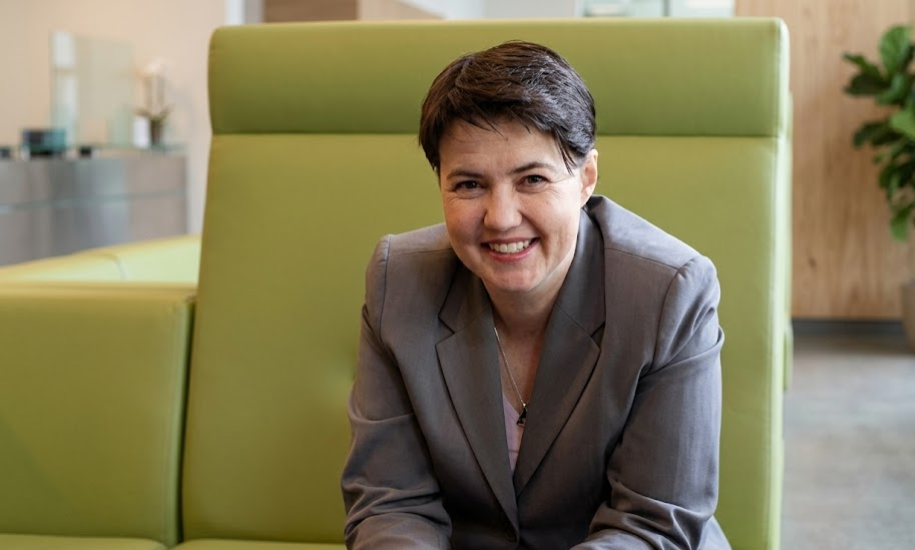

In the crowded landscape of modern British politics, few figures have commanded attention quite like Ruth Davidson. Bold, direct, and often disarmingly funny, she rose from relative obscurity to become one of the most talked-about politicians in the United Kingdom — not merely in Scotland, but across the entire British political establishment. Her story is one of personal courage, political reinvention, and a deep, abiding connection to the institutions that define British national life: the armed forces, the Scottish Parliament, and ultimately the House of Lords.
To understand Ruth Davidson is to understand three distinct but interwoven chapters of her life: her years in khaki as an army reservist; her turbulent, transformative decade leading the Scottish Conservative Party; and her elevation to the peerage as Baroness Davidson of Lundin Links, in the County of Fife. Together, these chapters tell the story of a woman who defied expectations at every turn.
Early Life and the Army: A Soldier Before a Politician
Ruth Elizabeth Davidson was born on 10 November 1978 in Bishopbriggs, North Lanarkshire. Before she ever set foot in a debating chamber or stood in front of a television camera, she wore a different kind of uniform. Davidson served in the Territorial Army — the reserve component of the British Army — for three years, an experience she has repeatedly described as one of the most formative of her life.
Her military ambitions were serious. She began officer training at the Royal Military Academy Sandhurst, the prestigious institution that has trained generations of British Army officers. However, her path through Sandhurst came to an abrupt and painful end. During a training exercise, Davidson jumped through a window and landed badly, breaking several vertebrae in her back. The injury ended her prospects of a full-time military career before it had properly begun.
Despite the injury, her connection to the armed forces never faded. She went on to work in broadcasting — notably as a journalist and presenter with BBC Scotland — before entering politics. Yet the soldier was never far from the surface. Her military bearing, her comfort with discipline and hierarchy, and her consistent championing of the armed forces throughout her political career all speak to those formative years in reserve service.
As Davidson herself once said: “I loved my time in uniform and am so grateful for everything it taught me — leadership, decision making, teamwork, confidence and moral courage.” These words were not merely rhetoric. They were the foundation upon which her entire public life was built.
The Honorary Colonel Controversy: Ruth Davidson and the Army
In June 2017, Davidson’s military connection was formally renewed when she was appointed Honorary Colonel of the 32nd Signal Regiment — the very unit in which she had served as a Territorial Army reservist. The appointment was presented as a natural fit: a politician with genuine military service history, taking on an ambassadorial role for a reserve regiment she knew personally and deeply respected.
Davidson expressed genuine delight at the appointment. She noted that reservists make up over a quarter of the British Army and that the skills gained through reserve service — leadership, decision-making, and confidence — are invaluable not just in uniform but in civilian life. For Davidson, the role was clearly personal, not merely ceremonial.
However, the appointment quickly attracted scrutiny. Documents released following a parliamentary question revealed that Davidson had been the only candidate put forward for the Honorary Colonel role. This raised eyebrows because the Reserve Land Forces Regulations specify that a minimum of two candidates should normally be sought for each Honorary Colonel position, to ensure a fair and open selection process. The role had also been signed off by Defence Secretary Sir Michael Fallon — a fellow Conservative — before receiving approval from senior officers on behalf of the Queen.
The Scottish National Party raised questions in Westminster, arguing that proper procedure had not been followed. The Ministry of Defence responded that while two candidates are preferred, single nominations are permissible under the regulations. The Scottish Conservative spokesperson dismissed SNP criticism, saying opponents were “utterly uninterested in speaking up for the armed forces.”
Fact-checkers at The Ferret investigated the controversy thoroughly and concluded that Davidson had not broken any Army rules. Her wearing of the uniform as part of the honorary appointment was deemed non-political and fully consistent with military regulations. She served in the Honorary Colonel role from 2017 until 2025 — making it one of the longer-standing and most personally meaningful elements of her post-leadership public identity.
Reshaping Scottish Conservatism: A Decade of Leadership
Davidson’s political career began when she was elected to the Scottish Parliament in 2011 as a List MSP for Glasgow. Almost immediately, she stood for the leadership of the Scottish Conservative Party — a party that had been reduced to a shadow of its former self north of the border. Against the odds and against the expectations of much of the party establishment, she won, gaining 2,278 first preference votes in the first round and ultimately defeating rival Murdo Fraser.
What followed was a decade of political reinvention that few would have predicted. Under Davidson’s leadership, the Scottish Conservatives went from a party in seemingly terminal decline to one with genuinely resurgent prospects. At the 2016 Scottish Parliament election, the party doubled its number of MSPs, replacing Labour as the second-largest party in Holyrood — a result that stunned political observers across the country. In the 2017 UK general election, the Scottish Conservatives won 13 seats in Scotland, their best result since 1983.
Throughout this period, Davidson built a national profile that eclipsed many of her Westminster counterparts. She was widely tipped as a potential future UK party leader, though she consistently deflected such suggestions. She was frank about her personal life — coming out publicly as gay and later announcing a pregnancy following IVF treatment — and used her platform consistently to advocate for LGBTQ+ rights, the union between Scotland and the rest of the United Kingdom, and a centrist form of conservatism that at times placed her at odds with the more hardline elements of her party in Westminster.
In August 2019, shortly after Boris Johnson became Prime Minister, Davidson resigned the leadership of the Scottish Conservatives. She cited personal reasons, including the desire to spend more time with her young family, though political differences with the Johnson administration — particularly over Brexit and its implications for Scotland — were widely reported as a factor. She stood down at the 2021 Scottish Parliament election, bringing the curtain down on her decade at Holyrood.
The House of Lords: Baroness Davidson of Lundin Links, County of Fife
In July 2021, Ruth Davidson’s political journey entered a new and unexpected chapter. She was appointed a life peer, entering the House of Lords as Baroness Davidson of Lundin Links, of Lundin Links in the County of Fife. The title placed her firmly within the geography of her native Scotland — Lundin Links is a small coastal village in the East Neuk of Fife, known for its golf course and its position on the southern shore of the Firth of Forth.
The appointment was not without controversy. At just 42 years of age, Davidson was among the younger life peers in recent memory. Critics — particularly from the SNP and independence-supporting quarters — questioned whether her elevation to the unelected House of Lords was appropriate or democratic. Davidson herself reportedly bristled at being referred to as “Baroness” by a BBC reporter shortly after her appointment, making her objections known to the broadcaster’s management — with the predictable result that the media used the title as loudly and as frequently as possible thereafter.
In practice, Davidson has been an active contributor in the Lords. She made her maiden speech on 22 October 2021, choosing to support Baroness Meacher’s Assisted Dying Bill — a position consistent with her broadly liberal social values. She has used the Lords chamber to criticise cuts to British Army troop numbers and to voice opposition to the UK Government’s scheme to deport asylum seekers to Rwanda. In her first year as a member, she made six contributions to debates and claimed £24,521 in expenses.
Her registered interests in the Lords reflect her expanded post-politics portfolio. She serves as a Non-executive Director at Royal London Mutual Insurance Society Limited, at W A Baxter & Sons (Holdings) Limited — the well-known Scottish food manufacturer — and as a Director at Kirkholm Broadlands Limited, which operates in television programming and management consultancy. In January 2022, she began presenting a weekly programme on Times Radio, combining, in her own words, “my two great loves: politics and live broadcasting.”
Legacy and Influence: What Ruth Davidson Represents
Ruth Davidson remains a singular figure in British political life. She is one of the few politicians to have genuinely moved the dial for her party in Scotland at a time when doing so seemed almost impossible. She is openly gay, a mother, a former soldier, a broadcaster, a life peer, and a Conservative — a combination that defies easy categorisation and challenges assumptions about who British politicians are and can be.
She was included in Time magazine’s 100 Most Influential People of 2018. In January 2024, she competed in a celebrity edition of Mastermind, demonstrating the easy public affability that has always been central to her appeal. A member of the Church of Scotland, she counts dog walking, hillwalking, and kickboxing among her hobbies — a set of interests entirely consistent with a personality shaped in equal parts by army discipline and Scottish practicality.
Whatever one’s view of her politics, Davidson’s trajectory — from a broken back at Sandhurst to the red benches of the House of Lords, from a struggling regional party to national prominence — represents a genuinely compelling piece of modern British political history. The County of Fife gave its name to her title, the army gave her its values, and the House of Lords gave her a final platform. Together, they form the portrait of a woman who has never quite stopped surprising people.
For more in-depth coverage of British politics and the public figures who shape life across the United Kingdom, visit Brit Feed — your trusted source for British news, analysis, and political storytelling. At Brit Feed, we bring you the context and detail behind the headlines, from the Scottish Parliament to the corridors of Westminster and beyond.
you may also read Ben Griffiths – Husband of Journalist Sophy Ridge: Private Life, Background and Public Interest