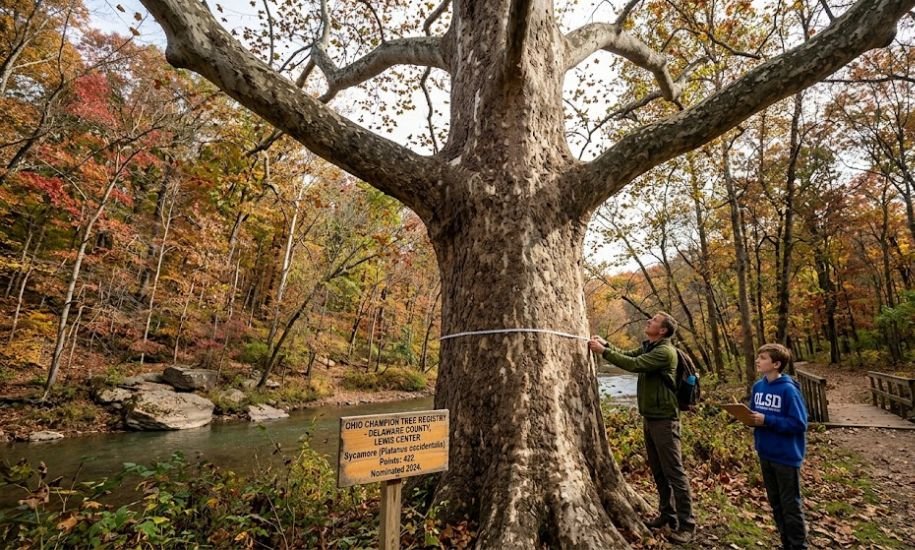

The landscape of Southern Delaware County is changing fast. Between the sprawling new developments of Lewis Center and the rapid expansion of the Olentangy Local School District (often searched as “USD” or “OLSD”), it’s easy to miss the silent, towering sentinels that have stood here since long before the first shovel hit the ground.
These are the Ohio Champion Trees. While many people think you have to drive down to the Hocking Hills to see old-growth giants, some of the most impressive specimens in the state are tucked away right here in our backyard—hidden in the ravines of Alum Creek and the shale bluffs of Highbanks Metro Park.
In this guide, we’re going beyond the dry government spreadsheets. We’re exploring the “living legends” of Delaware County, Lewis Center, and the specific trees that make our region a powerhouse in the Ohio Champion Tree registry.
What Exactly is an Ohio Champion Tree?
Before you head out into the Alum Creek basin with a measuring tape, it’s important to understand the “Champion” status. It isn’t just about being the tallest. The Ohio Department of Natural Resources (ODNR) and American Forests use a specific point system to determine if a tree is a “State” or “National” champion.
The Champion Formula:
To calculate a tree’s total points, experts use a mathematical “volume” estimate:
$$Points = \text{Circumference (inches)} + \text{Height (feet)} + \frac{1}{4} \text{Average Crown Spread (feet)}$$
This formula places a heavy emphasis on the circumference (measured at $4.5$ feet above the ground, known as “Breast Height” or CBH). This means a massive, thick-trunked oak can often outscore a thin, spindly tree that happens to be slightly taller.
The Giants of Lewis Center: Local Champions You Can Visit
Lewis Center is unique because it sits on a geological transition zone. The deep ravines carved by glacial meltwater thousands of years ago provide the perfect sheltered, moist environment for riparian giants to thrive.
1. The Alum Creek Eastern Cottonwood
If you head east from the heart of Lewis Center toward Alum Creek State Park, you’ll find one of the most famous trees in the state. Located near Cheshire Road at Africa Road, this Eastern Cottonwood (Populus deltoides) is a massive specimen.
- Why it’s special: At its peak, this tree scored over 520 points. To put that in perspective, a typical “large” backyard tree might score 150.
- The Sight: Its bark is deeply furrowed and warm-gray, appearing almost like stone from a distance. It towers over the surrounding canopy, soaking up the lion’s share of the sun along the reservoir’s edge.
2. The 500-Year-Old Sycamores of Highbanks
Technically straddling the line between Lewis Center and Powell, Highbanks Metro Park is home to two American Sycamores that are local celebrities.
- The Specs: These trees are roughly 23–24 feet in circumference.
- The Insight: Most competitors’ lists just give you the numbers. What they miss is the history: These trees are estimated to be 500 years old. They were saplings when the first European explorers were just beginning to map the interior of North America. Standing beneath their ghost-white upper branches is a humbling experience that no textbook can replicate.
The “USD” Connection: Trees and the Olentangy School District
When residents search for “USD Lewis Center” in relation to trees, they are often looking for information on school-led conservation or trees located on Olentangy Local School District (OLSD) land.
The district serves a massive 95-square-mile area, much of which contains protected wetlands and woods.
- Educational Impact: Many students at Olentangy High School or Orange High School utilize these “Champion” specimens for environmental science projects.
- Pro-Tip for Parents: If you have a student in the “USD” (District), the Highbanks “Big Tree” trail is the single best local resource for seeing $CO_2$ sequestration and old-growth ecology in action without a long commute.
How to Find a Hidden Champion in Your Backyard
Delaware County is one of the fastest-growing counties in Ohio, which means many “undiscovered” champions are currently sitting in people’s backyards or in the wooded buffers behind new subdivisions.
What to look for:
- Species Diversity: Look for Bur Oaks, Chinquapin Oaks, and Blue Ash. These are native to our limestone-rich soil and can grow to massive proportions.
- The “Survivor” Signs: Look for trees with “stag-headed” tops (dead branches at the very top) or massive lower limbs that grow horizontally. This usually indicates the tree grew in an open field (perhaps an old farm) long before the woods grew up around it.
Step-by-Step: Measuring Your Tree
- Measure the Girth: Wrap a flexible tape around the trunk at $4.5$ feet high.
- Estimate the Height: You can use the “stick method” (holding a stick at arm’s length) or a clinometer app on your smartphone.
- Spread the Canopy: Measure the widest part of the branches and the narrowest, then average them.
Expert Insight: If you find a tree that you think beats a current Delaware County record, don’t keep it a secret! You can submit a nomination through the ODNR Division of Forestry website.
Comparison: Delaware County vs. The Rest of Ohio
While counties like Ashland and Hamilton often claim the “National” titles for species like the American Sycamore or River Birch, Delaware County is the state leader for riparian forest diversity. Because of the Olentangy and Alum Creek river systems, our “champion” density per square mile is among the highest in Central Ohio.
| Species | Typical Champion Score | Delaware County Avg. (Top 5%) |
| Eastern Cottonwood | 450+ | 510+ |
| American Sycamore | 400+ | 430+ |
| White Oak | 300+ | 320+ |
FAQs: Ohio Champion Trees in Delaware County
Where is the biggest tree in Lewis Center?
The largest easily accessible tree is the Eastern Cottonwood near the Cheshire Market at Alum Creek. However, many “unofficial” champions exist within the ravines of Highbanks Metro Park.
Does a Champion Tree have legal protection?
Surprisingly, no. A “Champion” designation is an honor, not a legal shield. This is why local conservation efforts by the Olentangy schools and Delaware County parks are so vital.
Can I nominate a tree on private property?
Yes, but you must have the owner’s permission. Most owners are thrilled to find out they are caretakers of a state treasure!
Conclusion: Why These Giants Matter
In a world of constant construction and digital noise, the Ohio Champion Trees of Delaware County offer us a rare link to the past. Whether you are a student in the Olentangy “USD” looking for a science project or a Lewis Center resident seeking a weekend adventure at Alum Creek, these trees are more than just wood and leaves—they are our local monuments.
At Brit Feed, we believe that understanding your local environment is the first step toward preserving it. Next time you’re driving down Route 23 or hiking the Alum Creek trails, look up. You might just be standing in the shadow of a world-record giant.
Are you ready to find the next champion? Grab a measuring tape, head to your local park, and let us know what you find in the comments below!