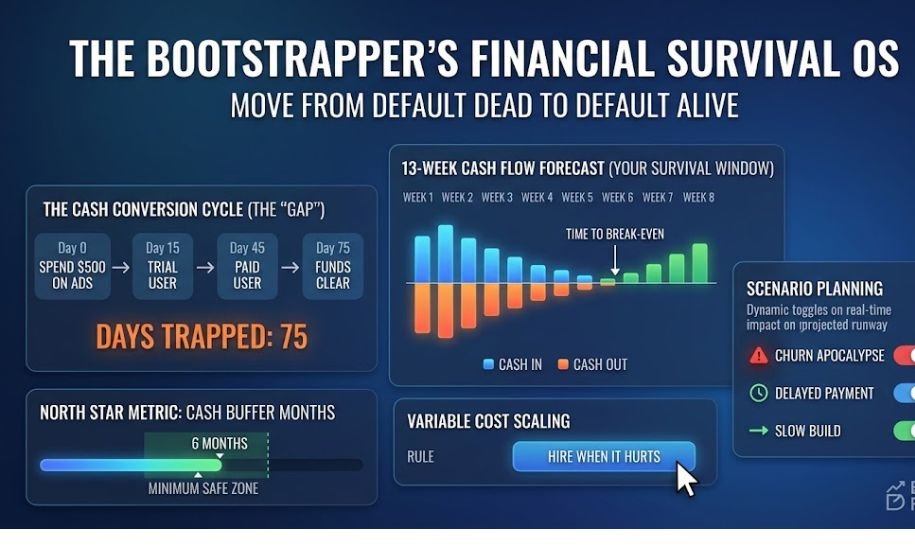

In the glittering world of Silicon Valley, financial modeling is often treated like a performance art—a series of “hockey stick” graphs designed to seduce Venture Capitalists into writing a check. But for the bootstrapper, a financial model isn’t a pitch deck accessory. It’s a survival instrument.
If you are “booting” your startup, your relationship with cash is visceral. You aren’t burning someone else’s millions; you are managing your own oxygen supply. At Brit Feed, we’ve seen countless brilliant ideas wither not because the product failed, but because the founder lost sight of the shoreline.
This guide is your compass to moving from Default Dead to Default Alive.
Why Traditional VC Financial Models Will Kill Your Bootstrapped Startup
Most financial templates you find online are “top-down” fantasies. They start with a massive market size ($10B!) and assume you’ll capture 1% of it through aggressive spending. For a bootstrapped founder, this approach is lethal.
Growth at All Costs vs. Sustainable Unit Economics
A VC-backed startup can afford a negative contribution margin for years. They buy growth. You, however, must sell your way to growth. Your model must prioritize Unit Economics—the micro-profitability of a single customer—from day one. If you lose $1 on every customer, “scaling” just means you go broke faster.
The Danger of “Paper Profits” vs. Actual Cash Flow
In accrual accounting, you might look profitable on an income statement while your bank account is empty. This happens because of the Cash Conversion Cycle. If you pay a developer today but the customer doesn’t pay you for 60 days, you have a “cash gap.” Traditional models often ignore this timing, but for a bootstrapped startup, timing is everything.
The 3 Pillars of a “Booted” Financial Model
To build a model that actually works in the trenches, you need to shift your focus from “potential” to “predictability.”
1. The Bottom-Up Revenue Forecast
Forget market share percentages. A bottom-up forecast starts with actions.
- How many cold emails can you send per day?
- What is the conversion rate to a demo?
- What is the closing rate?
By modeling your revenue based on your actual labor and budget constraints, you create a forecast that is tethered to reality, not hope.
2. Variable Cost Scaling: The “Hire When It Hurts” Rule
In a bootstrapped model, fixed costs are the enemy. Your financial plan should favor Variable Costs—expenses that only increase when revenue does. Instead of hiring a full-time marketing manager, model for a freelance contract that scales based on ad spend. Use the “Hire When It Hurts” rule: don’t add a salary to your model until the manual labor is actively preventing revenue growth.
3. The 13-Week Cash Flow Forecast
While a 3-year projection is nice for long-term vision, the 13-Week Cash Flow Forecast is your tactical dashboard. It tracks every dollar entering and leaving your account on a weekly basis. This granularity allows you to see a “cash crunch” coming three months away, giving you time to pivot, cut costs, or run a flash sale.
Step-by-Step: Building Your Survival Model in 48 Hours
You don’t need a complex ERP system. A clean Google Sheet or Excel file is your best friend.
Identifying Your North Star Metric
For many, this is Monthly Recurring Revenue (MRR), but for a bootstrapper, the true North Star is often Cash Buffer Months. This tells you exactly how many months you can survive if revenue hits zero tomorrow.
Mapping the Cash Conversion Cycle
This is where you identify “The Gap.”
- Day 0: Spend $500 on ads.
- Day 15: Lead converts to a trial.
- Day 45: Trial converts to a paid user.
- Day 75: The payment processor clears the funds to your bank.
In this scenario, your cash was “trapped” for 75 days. Your financial model must account for this delay, or you will run out of money while “growing.”
Scenario Planning: The “What-If” Stress Test
A great model is a playground for your anxieties. You should create three specific tabs in your spreadsheet:
- The “Churn Apocalypse”: What happens to your runway if your churn rate doubles next month? (Hint: This usually reveals that your customer success is underfunded).
- The “Delayed Payment” Scenario: What if your biggest B2B client pushes their Net-30 payment to Net-90?
- The “Slow Build”: If your growth rate stays flat for 12 months, do you stay Default Alive?
Recommended Tools for Lean Financial Modeling (2026 Edition)
While the giants use Anaplan, you need agility:
- Casual or Pry: Great for founders who want a visual layer over their spreadsheets without the complexity of traditional CFO software.
- Rows.com: A modern spreadsheet tool with built-in integrations to pull your Stripe or Shopify data directly into your model.
- Standard Excel: Still the king of flexibility. Use a “logic-locked” template where your assumptions are separated from your formulas.
Frequently Asked Questions
What is the difference between a VC model and a bootstrapped model? A VC model is built to show “Exit Value” and “Total Addressable Market.” A bootstrapped model is built to show “Break-even Point” and “Cash Flow positive” dates. One is about the destination; the other is about the fuel.
How much runway should a bootstrapped startup have? Ideally, you want to reach “Infinite Runway”—where your revenue exceeds your expenses. Until then, a 6-month buffer is the gold standard. Anything less than 3 months is a “Code Red” situation.
Should I include my own salary in the model? Yes. A business that only works because the founder is working for free isn’t a business—it’s a hobby. Even if you don’t take the cash yet, model a “Market Rate” salary for yourself so you know when the business is truly sustainable.
Conclusion: Moving Toward Freedom
Financial modeling for a bootstrapped startup isn’t about hitting exact numbers; it’s about understanding the levers of your business. When you know that increasing your conversion rate by 1% extends your runway by four months, you stop guessing and start operating.
The goal of every “booted” startup is to reach the point where you own your time and your equity. At Brit Feed, we believe that financial literacy is the ultimate competitive advantage for the independent founder. Build your model, respect the cash gap, and stay “Default Alive.”