
In today’s fast-moving and highly competitive business environment, decisions based on intuition alone are no longer sufficient. Organizations need reliable, data-driven insights to understand their markets, anticipate trends, and stay ahead of competitors. This is where market intelligence tools come into play.
Market intelligence tools have become essential for businesses of all sizes, from startups to multinational corporations. They enable companies to gather, analyze, and interpret vast amounts of data related to customers, competitors, and industry dynamics. With the right tools, businesses can uncover opportunities, reduce risks, and make informed strategic decisions.
This article provides a detailed and structured understanding of market intelligence tools, including their types, features, benefits, use cases, and future trends.
What Are Market Intelligence Tools?
Market intelligence tools are software platforms or systems designed to collect and analyze external market data. This data may include customer behavior, competitor activities, industry trends, pricing strategies, and economic conditions.
Unlike internal analytics tools that focus on company-specific data, market intelligence tools provide a broader perspective. They help businesses understand what is happening outside their organization and how it impacts their performance.
At their core, these tools transform raw data into meaningful insights that can guide business strategies. Whether it is identifying a new market opportunity or tracking competitor pricing changes, market intelligence tools play a critical role in decision-making.
Why Market Intelligence Tools Are Important
The importance of market intelligence tools lies in their ability to reduce uncertainty. Businesses operate in environments that are constantly changing, and having access to accurate and timely information is crucial.
One of the primary benefits is improved decision-making. When companies have access to real-time data, they can make faster and more confident decisions. This is particularly important in industries where trends shift rapidly, such as technology or e-commerce.
Another key advantage is competitive awareness. By monitoring competitors’ actions, businesses can respond proactively rather than reactively. This could involve adjusting pricing strategies, launching new products, or improving marketing campaigns.
Market intelligence tools also enhance customer understanding. By analyzing customer preferences, feedback, and behavior, companies can tailor their offerings to meet market demands more effectively.
Key Types of Market Intelligence Tools
Market intelligence tools can be categorized based on their primary functions. Each category serves a specific purpose and provides unique insights.
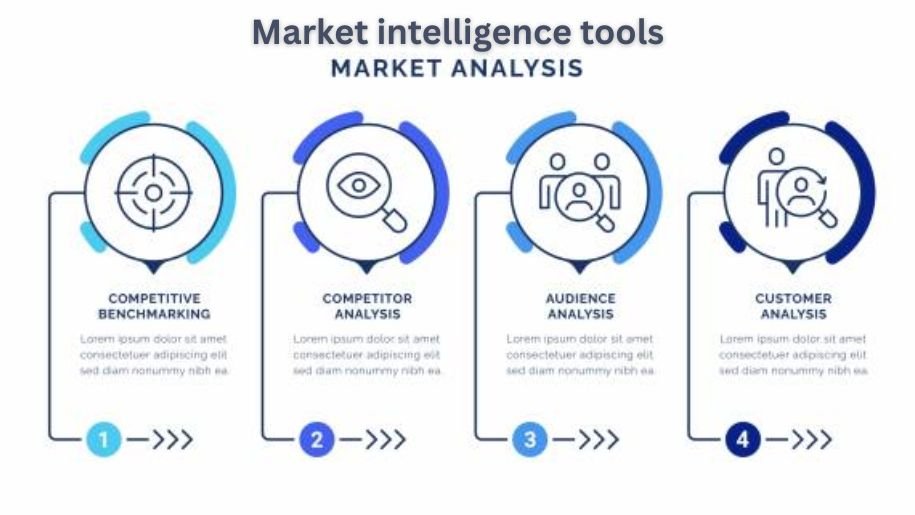
Competitive Intelligence Tools
Competitive intelligence tools focus on tracking and analyzing competitors. They monitor aspects such as product launches, pricing strategies, marketing campaigns, and online presence.
These tools help businesses understand their competitive landscape and identify gaps in the market. For example, if a competitor introduces a new feature, a company can quickly assess its impact and decide whether to respond.
Marketing Intelligence Platforms
Marketing intelligence platforms analyze customer interactions, campaign performance, and brand perception. They often include features like social listening, sentiment analysis, and audience segmentation.
These tools enable marketers to refine their strategies, improve targeting, and measure the effectiveness of their campaigns. By understanding how customers perceive a brand, companies can make adjustments to strengthen their positioning.
SEO and Digital Intelligence Tools
SEO and digital intelligence tools focus on online visibility and performance. They analyze website traffic, keyword rankings, backlinks, and competitor digital strategies.
These tools are particularly valuable for businesses that rely on digital channels for growth. They provide insights into how users find and interact with content, helping companies optimize their online presence.
Sales Intelligence Tools
Sales intelligence tools provide data about potential customers, companies, and decision-makers. They are widely used in business-to-business environments to identify leads and improve sales outreach.
By leveraging these tools, sales teams can personalize their communication and target the right audience more effectively. This leads to higher conversion rates and more efficient sales processes.
Customer and Market Research Tools
Customer research tools focus on gathering feedback and understanding user experiences. They often include surveys, feedback forms, and sentiment analysis features.
These tools are essential for product development and customer experience management. They help businesses identify pain points, measure satisfaction, and validate new ideas before launching them in the market.
Data Aggregation and Analytics Tools
Data aggregation tools collect information from multiple sources and present it in a unified dashboard. They simplify data analysis by providing visualizations and automated reports.
These tools are particularly useful for organizations that deal with large volumes of data. They reduce manual effort and enable teams to focus on interpreting insights rather than collecting data.
Core Features of Market Intelligence Tools
Market intelligence tools come with a wide range of features designed to streamline data collection and analysis. One of the most important features is data integration. These tools can pull information from various sources, including websites, social media platforms, and databases.
Another essential feature is real-time monitoring. Businesses can track changes in the market as they happen, allowing them to respond quickly to new developments.
Visualization and reporting capabilities are also critical. Dashboards, charts, and graphs make it easier to understand complex data and communicate insights to stakeholders.
Many modern tools incorporate artificial intelligence and machine learning. These technologies enable predictive analytics, helping businesses forecast trends and identify opportunities before they become obvious.
Automation is another key feature. Tasks such as data collection, report generation, and alert notifications can be automated, saving time and reducing errors.
How Market Intelligence Tools Work
Market intelligence tools operate by collecting data from multiple external sources. This data is then processed and analyzed to generate insights.
The process typically involves several steps. First, the tool gathers data through APIs, web scraping, or integrations with other platforms. This data may include competitor websites, social media posts, customer reviews, and industry reports.
Next, the data is cleaned and organized to ensure accuracy. Advanced tools use algorithms to filter out irrelevant or duplicate information.
Once the data is prepared, it is analyzed using statistical models and machine learning techniques. The results are then presented in a user-friendly format, such as dashboards or reports.
Users can interact with the data, apply filters, and generate customized reports based on their specific needs.
Benefits of Using Market Intelligence Tools
The benefits of market intelligence tools extend across multiple aspects of business operations.
One of the most significant advantages is improved strategic planning. With access to accurate market data, businesses can develop strategies that are aligned with current trends and future projections.
Another benefit is risk reduction. By identifying potential threats and opportunities early, companies can take proactive measures to minimize risks.
Market intelligence tools also enhance efficiency. Automation reduces the time spent on manual data collection and analysis, allowing teams to focus on higher-value tasks.
Customer satisfaction is another area that benefits from these tools. By understanding customer needs and preferences, businesses can deliver better products and services.
Additionally, these tools support innovation. By analyzing market trends and customer feedback, companies can identify new ideas and opportunities for growth.
Common Use Cases
Market intelligence tools are used in a variety of business scenarios.
In competitive strategy, they help companies monitor competitors and identify market gaps. This information can be used to refine positioning and differentiate products.
In marketing, these tools are used to optimize campaigns and improve targeting. By analyzing customer behavior, marketers can create more effective messages and reach the right audience.
Product development teams use market intelligence tools to gather feedback and validate ideas. This reduces the risk of launching products that do not meet market needs.
Sales teams rely on these tools to identify leads and understand customer preferences. This enables more personalized and effective outreach.
Another important use case is trend forecasting. Businesses can anticipate changes in the market and adjust their strategies accordingly.
Challenges and Limitations
Despite their many benefits, market intelligence tools are not without challenges.
One common issue is data quality. Inaccurate or incomplete data can lead to misleading insights. It is important for businesses to ensure that their data sources are reliable.
Another challenge is data overload. With so much information available, it can be difficult to identify what is truly relevant. This requires careful filtering and analysis.
Cost can also be a concern, especially for small businesses. Some advanced tools can be expensive, making it important to choose solutions that provide the best value.
Integration with existing systems can be another challenge. Businesses need to ensure that their tools work seamlessly with their current technology stack.
Future Trends in Market Intelligence Tools
The future of market intelligence tools is closely tied to advancements in technology.
Artificial intelligence is expected to play an even larger role. Tools will become more capable of providing predictive insights and automated recommendations.
Real-time data processing will continue to improve, enabling businesses to respond instantly to market changes.
Another emerging trend is data unification. Tools will increasingly integrate data from multiple sources to provide a holistic view of the market.
User experience is also likely to improve. Interfaces will become more intuitive, making it easier for non-technical users to access and interpret data.
Finally, there will be a greater focus on privacy and data security. As regulations become stricter, tools will need to ensure compliance while still delivering valuable insights.
Conclusion
Market intelligence tools have become indispensable in the modern business landscape. They provide the insights needed to navigate complex markets, understand customers, and stay ahead of competitors.
By leveraging these tools, businesses can make informed decisions, reduce risks, and identify new opportunities for growth. While challenges exist, the benefits far outweigh the limitations.
As technology continues to evolve, market intelligence tools will become even more powerful and accessible. Companies that embrace these tools will be better positioned to succeed in an increasingly competitive world.
Frequently Asked Questions
What is the main purpose of market intelligence tools?
The main purpose of market intelligence tools is to collect and analyze external market data, helping businesses make informed strategic decisions.
How are market intelligence tools different from business intelligence tools?
Market intelligence tools focus on external data such as competitors and market trends, while business intelligence tools focus on internal company data.
Are market intelligence tools suitable for small businesses?
Yes, many tools are designed for businesses of all sizes. Small businesses can benefit from affordable solutions that provide essential insights.
Can market intelligence tools predict future trends?
Many advanced tools use artificial intelligence and predictive analytics to forecast trends, although predictions are not always guaranteed.
What industries use market intelligence tools the most?
Market intelligence tools are widely used across industries, including technology, retail, finance, healthcare, and e-commerce.