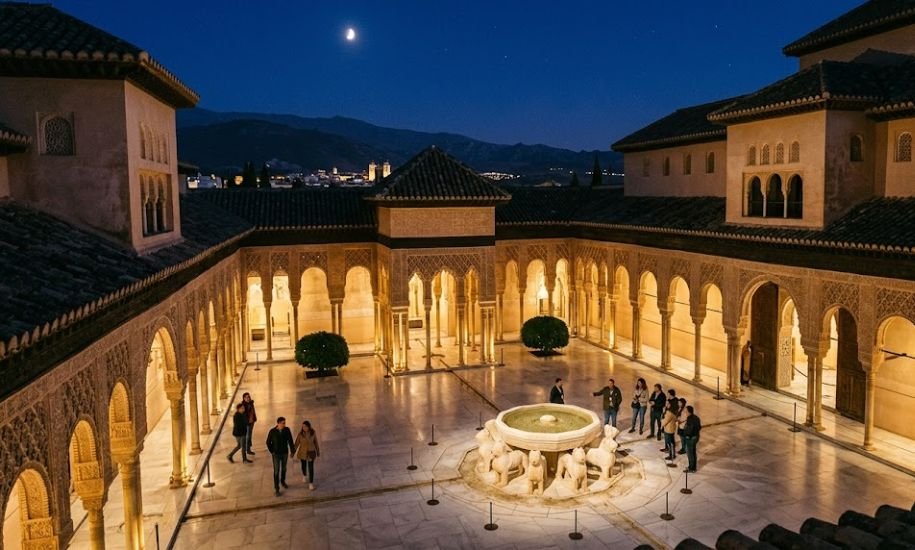

The Alhambra of Granada isn’t just a monument; it is a masterclass in the “economy of scarcity.” As a traveler or an industry observer, you’ve likely noticed that securing a ticket to this UNESCO World Heritage site feels like winning the lottery. But while millions scramble for a daytime slot under the blistering Andalusian sun, a much quieter, more exclusive financial model is at play once the sun dips below the Sierra Nevada.
If you are looking into the Alhambra night tour attendance revenue, you aren’t just looking for a ticket—you are looking for the “insider” math. Is the night tour a better value? Does the lower attendance translate to a better experience? And how does your ticket price actually contribute to the survival of the Nasrid Dynasty’s legacy?
In this 2026 report, we break down the hard numbers, the seasonal attendance shifts, and the economic impact of Granada’s most famous moonlit secret.
1. Attendance by the Numbers: Night vs. Day Capacity
To understand the value of a night tour, you have to look at the sheer density of humans. The Alhambra management (the Patronato de la Alhambra) operates on a strict “carrying capacity” model to prevent the delicate plasterwork from being eroded by the humidity of thousands of breaths.
The Scarcity Factor
- Daytime Capacity: Currently, the Alhambra allows approximately 6,600 to 7,000 visitors per day. Over a year, this totals roughly 2.6 to 2.7 million people.
- Nighttime Capacity: The night tour is restricted to a fraction of that. On any given night, only about 400 to 500 lucky individuals are permitted into the Nasrid Palaces.
The Insider Insight: While the daytime visit feels like a bustling hive of tour groups and umbrellas, the night visit offers a 92% reduction in foot traffic. When you analyze attendance, you aren’t just buying a ticket; you are buying the silence that allows you to hear the water trickling in the Court of the Lions—a sound virtually unheard during the day.
Nasrid Palaces at Night: High-Value-Per-Visitor
The “Night Visit to the Nasrid Palaces” is the crown jewel of the nocturnal schedule. Because the palaces are enclosed, the humidity and temperature are monitored via a Sustainability Laboratory. By capping attendance at such a low number, the monument ensures that the “value-per-visitor” remains high, even if the total volume is low.
2. The Revenue Breakdown: Where Your Ticket Money Goes
Many visitors assume that the Alhambra is a massive “cash cow” for the Spanish government. While it does generate significant income, the Alhambra night tour revenue is specifically engineered to balance accessibility with high-cost preservation.
Pricing Tiers for 2026
Official prices have seen a slight adjustment for the 2026 season to account for increased energy costs for the complex’s advanced nocturnal LED lighting system.
| Ticket Type | Official 2026 Price (Approx.) | Access Included |
| Nasrid Palaces Night | €10.61 – €12.73 | Nasrid Palaces & Charles V Palace |
| Generalife Night | €8.48 | Generalife Gardens & Palace |
| Alhambra Experiences | €22.27 | Night Nasrid + Day Generalife/Alcazaba |
| Dobla de Oro Night | €23.06 | Night Nasrid + 5 Albaicín Monuments |
Funding Conservation
The revenue isn’t just profit. A single night tour session might generate roughly €5,000 to €6,500 in direct ticket sales. While this seems modest compared to the daytime’s €140,000+ daily haul, the night tours have a much higher profit-to-impact ratio.
Since night tours only open a specific route (the Nasrid Palaces or the Generalife, rarely both at once), the staffing costs are lower, yet the revenue directly funds the lighting maintenance and nocturnal security teams—essential components that prevent the monument from being a “dead” space after dark.
3. Attendance Trends: When is the Alhambra Least Crowded?
If you are tracking attendance to plan your trip, timing is everything. Data from the sustainability reports shows clear patterns:
- The Weekend Spike: Friday and Saturday nights are almost always at 100% capacity. If you are looking for that “empty palace” feeling, these are the hardest nights to book.
- The Mid-Week Secret: In the 2026 season, Tuesday and Wednesday night tours (available during the summer schedule) often hover at 85% capacity. This 15% gap is the difference between a crowded corridor and a private moment in the Hall of the Ambassadors.
- Seasonal Fluctuations: May and October remain the “peak” months for attendance. Paradoxically, January and February night tours are the most atmospheric, with attendance dropping significantly, though you’ll need to brave the crisp Granada mountain air.
4. The Economic ROI of a Night Visit: Is it Worth It?
Is the night tour a “smart” purchase? Let’s look at the Return on Investment (ROI) for the average traveler.
- Photography Access: During the day, taking a photo without a tourist in the background is a Herculean task. At night, the lighting is specifically designed to highlight the geometry of the muqarnas (honeycomb vaulting). For a photographer, the €10.61 ticket is an absolute bargain.
- Temperature Management: In July, Granada can hit 40°C. The night tour offers a cool, breezy alternative that saves you the physical “cost” of heat exhaustion.
- The “Scarcity” Advantage: Because the night tour does not include the Alcazaba (the fortress) or the full gardens, you are paying for the “best bits” without the filler. It is a distilled, high-impact version of the Alhambra.
5. Summary of Key Data (2026 Forecast)
- Total Annual Visitors (Night): Est. 75,000 – 90,000.
- Estimated Nightly Revenue: €5,000 – €7,500 per session.
- Primary Revenue Driver: The “Alhambra Experiences” ticket (combined day/night).
- Attendance Limit: ~450 people per shift.
6. FAQs: Everything You Need to Know
Q: Can I see the Lion’s Fountain at night?
A: Yes! The night tour route through the Nasrid Palaces includes the Court of the Lions. It is arguably the most beautiful part of the night experience.
Q: Does the night tour include the Generalife?
A: Usually, no. The “Nasrid Palaces Night Visit” and the “Generalife Night Visit” are separate tickets. If you want to see both, you should look into the “Alhambra Experiences” ticket which spans two days.
Q: Is a passport mandatory for the night tour?
A: Absolutely. Since 2024, security has tightened. You must have your physical passport (or ID for EU citizens) as tickets are strictly nominative.
Conclusion: The “Brit Feed” Verdict
The Alhambra night tour attendance revenue model is a testament to how a historic site can remain profitable while prioritizing conservation. By limiting attendance to a mere 5% of its daytime volume, the Patronato creates an “exclusive” atmosphere that feels like a private viewing.
For the savvy traveler, the night tour isn’t just a secondary option—it is the superior economic choice. You pay less than a daytime ticket, you avoid the crushing crowds, and you see the palaces in the same intimate, flickering light that the Sultans once did.
At Brit Feed, we believe the best travel experiences are the ones where you understand the “why” behind the “where.” The night tour is a rare example of a tourist attraction where less truly is more.
Ready to see the moonlight on the Alhambra? Book your tickets at least 3 months in advance via the official Patronato website—because with only 400 spots a night, they disappear faster than a Granada sunset.