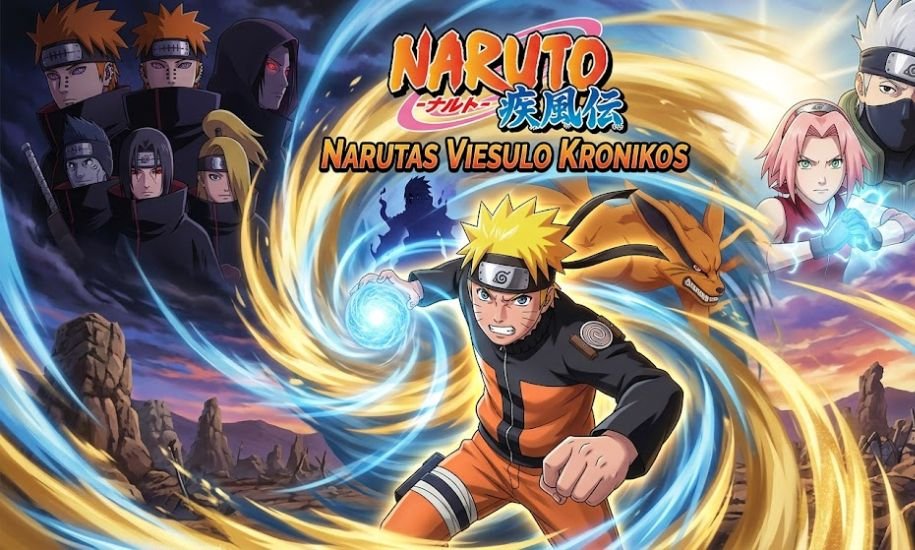

The title Narutas Viesulo Kronikos carries a specific weight for fans who followed the journey of the world’s most famous ninja through various linguistic lenses. Known globally as Naruto Shippuden, the “Hurricane Chronicles” represent more than just a time-skip in an anime series; they represent a cultural phenomenon that redefined the “shonen” genre. Spanning 500 episodes, this saga transformed a story about a mischievous prankster into a sprawling epic about war, peace, philosophy, and the cycle of hatred.
The Return of the Hero: Setting the Stage
Narutas Viesulo Kronikos begins two and a half years after the original series concludes. Naruto Uzumaki, having left the Hidden Leaf Village (Konohagakure) to train with the legendary Sannin, Jiraiya, returns as a teenager. He is taller, stronger, and more disciplined, but his core remains unchanged: he is still the boy who dreams of becoming Hokage to earn the respect of his peers.
However, the world he returns to is not the one he left. The geopolitical climate of the Five Great Shinobi Nations has grown cold. The shadow of the Akatsuki, a rogue organization of S-rank criminals, looms over the world. Their goal is simple yet terrifying: capture all nine Tailed Beasts (Bijuu) to create a weapon of absolute power. As the host of the Nine-Tails, Naruto is no longer just a ninja; he is a target.
The Evolution of the Shinobi World
One of the most striking aspects of the “Hurricane Chronicles” is the expansion of the world-building. In the early years, the scope was largely limited to the internal politics of Konoha. In this sequel, the curtain is pulled back on the entire continent.
- The Hidden Sand (Sunagakure): We see the growth of Gaara from a bloodthirsty monster to a respected Kazekage, highlighting the theme that no one is beyond redemption.
- The Hidden Rain (Amegakure): This village serves as the somber backdrop for the origin of the Akatsuki, introducing themes of industrialization and the collateral damage of wars fought by larger nations.
- The Five Kage Summit: This pivotal arc brings the leaders of the five greatest villages together, showcasing the intricate diplomacy and historical grudges that have fueled decades of conflict.
The Antagonists: More Than Just Villains
What elevates Narutas Viesulo Kronikos above many of its contemporaries is the depth of its antagonists. The members of the Akatsuki are not “evil for the sake of evil.” Each member represents a different philosophy or human failure:
- Pain (Nagato): Perhaps the most philosophical villain in anime, Pain challenges Naruto’s worldview by arguing that peace can only be achieved through shared pain and mutual fear.
- Itachi Uchiha: Initially presented as a cold-blooded traitor, his eventual reveal as a tragic hero who sacrificed his soul for the safety of his village remains one of the greatest plot twists in literary history.
- Obito Uchiha: A mirror image of Naruto, Obito shows what happens when a kind-hearted dreamer loses hope and is consumed by the “Curse of Hatred.”
The conflict between Naruto and these villains is rarely just physical. It is a battle of ideologies. Naruto’s greatest strength isn’t his Rasengan or his Shadow Clones; it is his “Talk no Jutsu”—his ability to empathize with his enemies and convince them that there is a better way to live.
Power Scaling and the Arts of Ninjutsu
As the series progresses, the power levels reach astronomical heights. The “Hurricane Chronicles” introduced several legendary concepts that became staples of the franchise:
- Nature Transformation: We learn that chakra is not just energy, but is tied to elements (Fire, Wind, Lightning, Earth, Water). Naruto’s mastery of the Wind Style: Rasenshuriken marks his transition into an elite-level fighter.
- Sage Mode (Sennin Modo): By harnessing natural energy, Naruto transcends human limits. The training arc at Mount Myoboku is widely considered one of the best “training montages” in fiction.
- The Mangekyo Sharingan: The evolution of the Uchiha eye powers introduces god-like abilities like Amaterasu (unquenchable black flames) and Susanoo (a spectral warrior protector).
The Fourth Shinobi World War: A Narrative Peak
The final third of Narutas Viesulo Kronikos is dedicated to the Fourth Shinobi World War. This is where the series shifts from tactical ninja strikes to a grand-scale supernatural war.
For the first time in history, the five villages unite under a single banner. This arc brings back deceased legends through the Edo Tensei (Reanimation Jutsu), allowing fans to see Naruto and his peers interact with the heroes of the past, including the previous Hokages.
The war serves as the ultimate test of Naruto’s philosophy. Can he truly shoulder the hatred of the entire world? The climax, featuring the resurrection of the Ten-Tails and the emergence of Madara Uchiha, pushes the animation and storytelling to its absolute limit. Madara, in particular, stands as a titan of the series—a warrior so powerful that his very name struck fear into the hearts of the Allied Shinobi Forces.
The Core Bond: Naruto and Sasuke
At its heart, Narutas Viesulo Kronikos is a story about two brothers. Naruto represents the “Will of Fire” (hope, community, and love), while Sasuke Uchiha represents the “Curse of Hatred” (isolation, power, and revenge).
Sasuke’s journey is the dark parallel to Naruto’s. While Naruto seeks to be acknowledged by the village, Sasuke seeks to destroy the village that he believes ruined his family. Their final battle at the Final Valley is not just a fight to the death; it is a fight for the soul of the shinobi world.
When the dust settles, the resolution isn’t found in a killing blow, but in a handshake. Naruto’s refusal to give up on Sasuke, even when the entire world labeled him a criminal, is the ultimate validation of his character. It proves that bonds are the only thing capable of breaking the cycle of violence.
Cultural Impact and Philosophy
Beyond the flashy battles and supernatural powers, Narutas Viesulo Kronikos deals with profound questions:
- Can we ever truly understand one another?
- Is world peace a realistic goal or a beautiful dream?
- How do we deal with the legacy of our ancestors’ mistakes?
The series teaches its audience that being a “hero” isn’t about being the strongest; it’s about having the endurance (Nintai) to suffer through hardship without losing one’s heart.
Summary Table: The Journey of the Hurricane
| Arc Name | Primary Focus | Key Character Development |
| Kazekage Rescue | Introduction of the Akatsuki | Sakura proves her strength; Gaara is saved. |
| The Tale of Jiraiya the Gallant | The infiltration of the Rain Village | Jiraiya’s tragic end and the passing of the torch. |
| Fated Battle Between Brothers | Sasuke vs. Itachi | The truth about the Uchiha Massacre is revealed. |
| Pain’s Assault | The destruction of Konoha | Naruto is finally recognized as the Hero of the Leaf. |
| The Fourth Shinobi World War | Global Unification | Naruto and Kurama become true partners. |
| The Final Battle | Naruto vs. Sasuke | The cycle of reincarnation and hatred is broken. |
Conclusion: Why it Endures
Even years after its conclusion, Narutas Viesulo Kronikos remains a titan of the industry. It successfully bridged the gap between a children’s adventure and a mature epic. It gave us a protagonist who felt like a friend—someone we watched grow from a lonely orphan into a father, a leader, and a legend.
The “Hurricane Chronicles” reminded us that while the “wind” of change can be violent and destructive, it is also the force that clears the path for a new spring. Naruto Uzumaki did more than just become Hokage; he changed the hearts of everyone he met, and in doing so, he changed the hearts of a generation of viewers. Whether you call it Shippuden or Narutas Viesulo Kronikos, the story remains an eternal testament to the power of the human spirit.
find more at britfeed