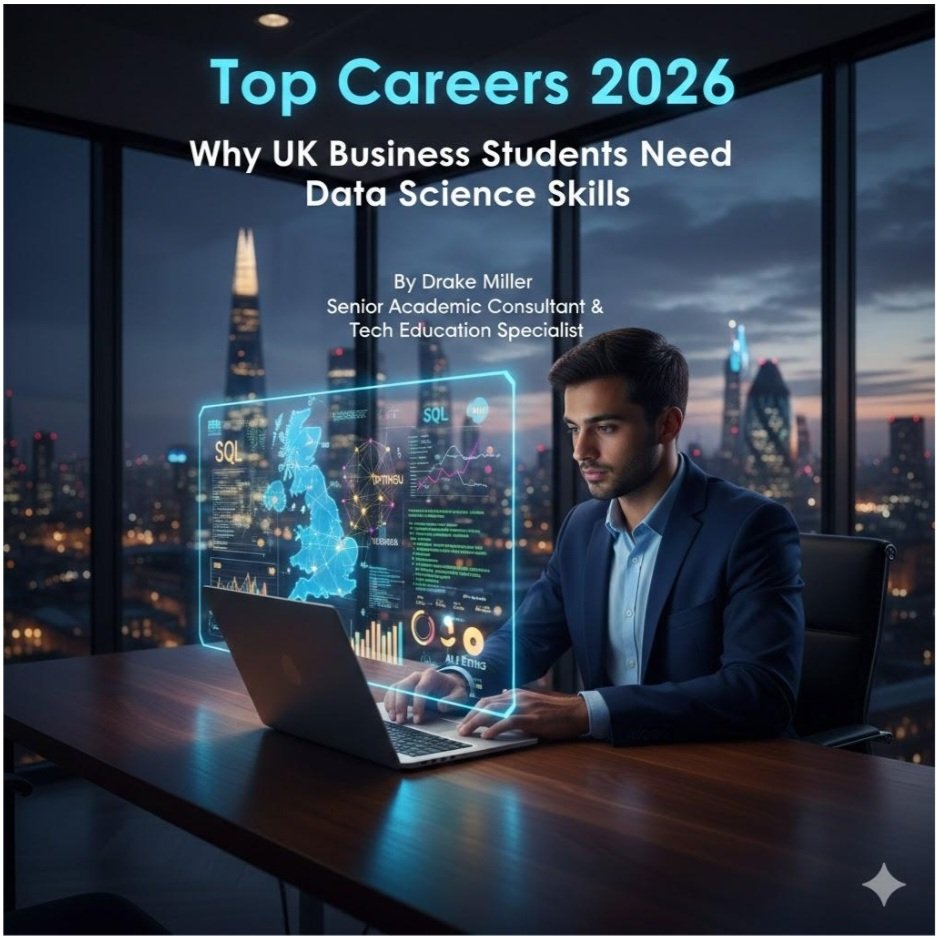

By Drake Miller
Senior Academic Consultant & Tech Education Specialist
The corporate landscape of 2026 looks fundamentally different from that of a decade ago. We have moved past the era where “tech” was a siloed department; today, the boardroom and the server room have merged. As a senior academic consultant at Myassignmenthelp.com, I have spent years observing the shift in recruitment patterns across the UK. One reality is now non-negotiable: data science for business students is no longer a “niche interest”—it is the new global language of commerce.
If you are a high school student in London weighing your A-Levels, a T-Level student in Manchester gaining industry placement, or an undergraduate in Edinburgh, the message is clear: the “traditional” business degree is evolving. To succeed, you must become a “Digital Translator.”
The Great Shift: From Intuition to Data-Driven Logic
Historically, UK business was often driven by “gut instinct.” A retail manager would decide on stock levels based on last year’s sales. In 2026, that same manager uses predictive analytics to forecast demand based on real-time social media sentiment, local weather patterns, and global supply chain fluctuations.
Data science is the process of extracting actionable insights from raw data. For a business student, this doesn’t mean building complex neural networks. However, you must understand how to interpret them. When a machine learning model suggests a price hike, you need to know the “why” behind the “what” to communicate it effectively to stakeholders.
Many students find the transition from qualitative business theory to quantitative data application to be a steep learning curve. This is where specialized academic help — including professional assignment writing services we facilitate — becomes an invaluable bridge, helping students master these technical requirements before they enter the high-stakes UK job market.
Why 2026 is the Turning Point for UK Graduates
We are witnessing the “democratization of data.” Tools once requiring PhD-level maths are now accessible through low-code platforms. However, the tool is only as useful as the person wielding it.
UK businesses, from the fintech hubs of Canary Wharf to the “Northern Powerhouse” creative agencies, are desperate for graduates who can bridge the gap between technical data output and commercial strategy. If you can read a Python script and a Balance Sheet with equal fluency, you become the most valuable person in the room.
The UK National Data Strategy
The UK government’s National Data Strategy highlights a significant “data skills gap” threatening economic growth. This affects the NHS, high-street retail, and local government. By entering the workforce with these skills, you aren’t just a job seeker—you are a solution to a national economic priority.
5 Core Pillars of Tech Literacy for Students
To stay competitive in the 2026 UK job market, students should focus on:
- Data Visualization (Tableau/PowerBI): Turning complex datasets into compelling narratives for CEOs.
- AI Ethics & GDPR: Navigating the moral landscape of automation and the UK’s evolving regulatory framework.
- Database Logic (SQL & Python): Speaking the same language as technical teams to reduce project friction.
- Strategic Automation (RPA): Designing workflows that automate mundane tasks using “bots.”
- Financial Modeling: Integrating external APIs (stock feeds/currency) directly into financial statements.
Overcoming “Maths Anxiety” in the UK Curriculum
A common trend I see at Myassignmenthelp.com is “Maths Anxiety.” Many students choose business to avoid the “hard sciences.” This is a misconception. Modern data science is more about logic and pattern recognition than solving complex calculus on a chalkboard.
However, academic challenges are not limited to numbers. Many students also seek help with English assignment tasks to improve analytical writing, research structuring, and professional communication skills — all of which are equally vital in a data-driven business world. Strong written communication complements technical expertise.
For high school students weighing A-Level, BTEC, or T-Level choices, incorporating Mathematics or Statistics alongside Business Studies is a “power move.” If you struggle with the technical overlap, seeking targeted academic guidance can ensure university-level modules aren’t a shock to the system.
High-Paying Careers: The Financial Edge for UK Graduates
Graduates with high tech literacy often command salaries 20-30% higher than their traditional counterparts.
| Role | Estimated Starting Salary (UK 2026) | Required Tech Skill |
| Junior Business Analyst | £38,000 – £45,000 | SQL & Tableau |
| Marketing Data Specialist | £35,000 – £42,000 | Python & GA5 |
| Fintech Consultant | £42,000 – £50,000 | Blockchain & RPA |
| Supply Chain Analyst | £36,000 – £44,000 | Predictive Modeling |
Frequently Asked Questions
Q.1 Is a T-Level better than an A-Level for Tech Literacy?
T-Levels offer 45-day industry placements for hands-on experience. However, A-Levels (Business, Maths, Computer Science) remain the gold standard for Russell Group universities. Both are viable if you build a digital portfolio.
Q.2 Why is Python recommended over other languages?
Python has an “English-like” syntax, making it the most accessible language for non-programmers and the industry standard for UK corporate data analysis.
Q.3 How can I catch up if my school doesn’t offer Data Science?
Many students supplement lectures with online certifications or use platforms like MyAssignmentHelp to master the technical components of their coursework.
The Verdict: Adapt or Get Left Behind
By 2026, “Data Science” will likely just be called “Business.” The two are inseparable. For the UK student, tech literacy is your passport to the global economy. Will you be the one interpreting the data, or the one wondering what the numbers mean?
About the Author
Drake Miller is a senior content manager and academic consultant at Myassignmenthelp.com. With over a decade in the UK education sector, he specializes in bridging the gap between academic theory and the technical demands of the modern workforce.