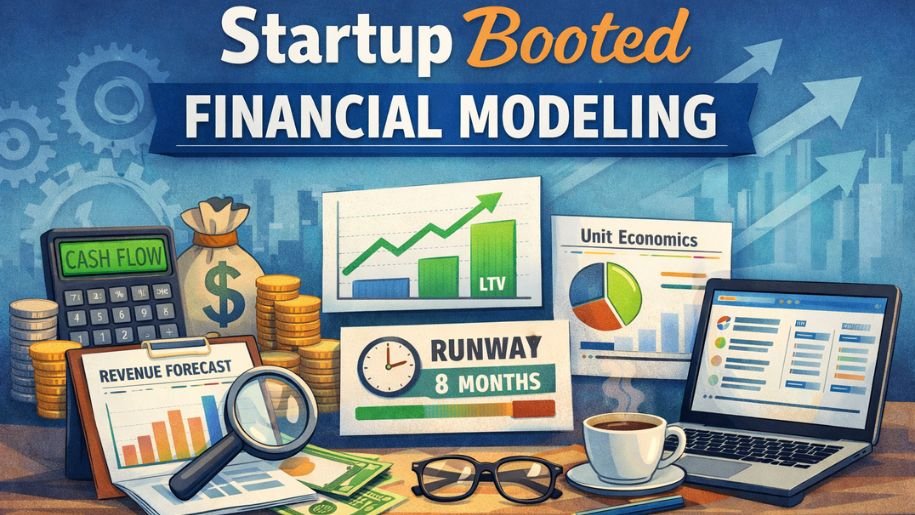

Startup booted financial modeling refers to the process of building a structured financial plan for a business that is funded without external venture capital. In this approach, founders rely on personal savings, early customer revenue, reinvested profits, or minimal outside assistance. Unlike venture-backed startups that prioritize rapid scale fueled by external funding, bootstrapped businesses must operate with financial discipline, controlled growth, and careful cash management.
Financial modeling in this context becomes more than a forecasting exercise. It acts as a survival tool. A well-built financial model enables founders to anticipate cash shortages, evaluate profitability timelines, measure sustainability, and make informed operational decisions. It provides visibility into revenue patterns, expense behavior, and capital requirements while ensuring the company does not outgrow its financial capacity.
Booted financial modeling is not about creating overly complex spreadsheets filled with abstract projections. It is about building a practical, decision-oriented framework that helps founders answer one central question: can this business sustain itself and grow without outside capital?
The Philosophy Behind Bootstrapped Financial Planning
The philosophy of bootstrapped financial modeling differs significantly from venture-funded financial modeling. Venture-backed startups often prioritize aggressive market capture, even if that means prolonged losses. Bootstrapped companies, on the other hand, focus on profitability, efficiency, and cash preservation.
In a bootstrapped environment, every dollar has opportunity cost. Hiring decisions, marketing campaigns, technology investments, and pricing strategies must be evaluated through the lens of cash flow impact. Financial modeling therefore becomes a strategic compass. It allows founders to test scenarios before committing resources.
The mindset behind booted modeling emphasizes resilience. Instead of asking how quickly the company can scale to millions in revenue, the founder asks how long current cash reserves will last, how quickly customer acquisition costs are recovered, and when the company will reach break-even. Sustainable growth replaces explosive expansion as the primary objective.
Core Components of a Booted Financial Model
A startup booted financial model typically begins with a structured assumptions section. This section contains the fundamental drivers of the business, including pricing, expected customer growth, churn rates, cost structure, hiring timelines, and operating expenses. Since these variables drive every projection, they must be realistic and grounded in available data rather than optimism.
Revenue modeling forms the next major component. In subscription businesses, revenue is often calculated through customer count multiplied by average revenue per user. For transactional businesses, revenue may depend on order volume and pricing. The key is to model revenue from the bottom up rather than applying arbitrary growth percentages. Founders should forecast how customers are acquired, retained, and monetized month by month.
Cost of goods sold and gross margin calculations are essential because they determine how much money remains after delivering the product or service. Bootstrapped startups cannot afford to ignore margin dynamics. A high-revenue business with weak margins may still face cash shortages. Strong gross margins create breathing room for reinvestment.
Operating expenses must be modeled carefully. Salaries, rent, software tools, marketing expenses, professional services, and administrative costs should be projected monthly. Bootstrapped companies often delay hiring and automate processes to control fixed costs. The model should clearly distinguish between fixed expenses and variable expenses so founders can adjust spending when revenue fluctuates.
The cash flow statement is the most critical element in booted financial modeling. Even profitable businesses can fail if cash is mismanaged. Modeling monthly cash inflows and outflows provides visibility into burn rate and runway. The model should show opening cash, net cash movement, and closing cash for each period. This allows founders to identify months where liquidity becomes tight and take corrective action in advance.
Understanding Burn Rate and Runway
Burn rate represents the amount of cash a company loses each month. In bootstrapped startups, controlling burn rate is fundamental to survival. Financial modeling makes burn rate visible and quantifiable. By comparing expenses against gross profit, founders can calculate net burn and determine whether the business is moving toward self-sufficiency.
Runway is calculated by dividing available cash by monthly net burn. It indicates how many months the company can operate before running out of money. In booted startups, maintaining sufficient runway provides operational flexibility and psychological stability. A model that forecasts diminishing runway forces the founder to adjust spending, accelerate revenue, or reconsider strategic priorities.
Modeling runway also encourages disciplined decision-making. For example, hiring a new employee may accelerate growth but shorten runway. The model helps evaluate whether the expected revenue increase justifies the reduced cash cushion.
Revenue Forecasting in Bootstrapped Startups
Revenue forecasting in booted financial modeling must be practical and conservative. Instead of assuming exponential growth from the outset, projections should be tied to realistic customer acquisition channels. If a startup relies on organic marketing, referrals, or content strategies, growth may be gradual but sustainable.
Customer acquisition cost plays a central role in revenue modeling. If acquiring a customer costs more than the lifetime value generated, the business model is flawed. Financial modeling allows founders to test different acquisition scenarios. By adjusting marketing spend and conversion rates, they can estimate how quickly customers are acquired and when acquisition investments are recovered.
Churn must also be incorporated. In subscription businesses, churn erodes revenue. Ignoring churn creates inflated revenue forecasts. Modeling monthly retention provides a clearer view of net growth and long-term sustainability.
Revenue forecasting should extend at least twelve to twenty-four months ahead, with monthly detail in the first year. This granularity reveals seasonality, marketing campaign impacts, and operational bottlenecks.
Unit Economics and Profitability Metrics
Unit economics form the analytical backbone of startup booted financial modeling. They measure the profitability of individual customer relationships. Two critical metrics are customer acquisition cost and lifetime value.
Lifetime value represents the total gross profit generated from a customer during their relationship with the company. It depends on average revenue, gross margin, and retention period. If lifetime value significantly exceeds acquisition cost, the company has a scalable model. If not, growth will strain cash reserves.
Another important metric is payback period, which measures how long it takes to recover acquisition costs. In bootstrapped businesses, shorter payback periods are preferable because they free up cash for reinvestment. A long payback period may be acceptable for venture-funded companies but can threaten liquidity in bootstrapped settings.
Gross margin percentage is also critical. High gross margins enable flexibility in pricing and marketing. Low margins restrict reinvestment capacity and increase vulnerability during slow revenue periods.
Scenario Planning and Sensitivity Analysis
Bootstrapped startups operate under uncertainty. Scenario planning within the financial model helps founders anticipate potential outcomes. A base case projection reflects realistic expectations. A conservative scenario accounts for slower growth or unexpected expenses. An optimistic scenario explores accelerated revenue growth.
Sensitivity analysis identifies which variables most significantly impact financial outcomes. For instance, slight changes in churn rate may drastically affect lifetime value. Minor increases in marketing costs may extend payback periods. By adjusting assumptions and observing outcomes, founders gain deeper insight into business dynamics.
Scenario modeling also reduces emotional decision-making. Instead of reacting impulsively to temporary fluctuations, founders can refer to structured projections and determine whether deviations fall within expected ranges.
Building the Model Step by Step
Constructing a booted financial model typically begins in spreadsheet software. The first sheet contains assumptions. The second sheet models revenue drivers. The third outlines expenses. The fourth integrates these components into income statements and cash flow projections.
Founders should ensure formulas are transparent and easy to audit. Overcomplicated models can obscure critical insights. Clarity is more valuable than complexity. Each projection should trace back to a logical assumption.
Regular updates are essential. A financial model is not static. Monthly actual results should replace forecasts, and assumptions should be refined accordingly. This iterative process transforms the model into a living management tool rather than a one-time planning document.
Common Mistakes in Booted Financial Modeling
One frequent mistake is overestimating revenue growth. Optimistic projections create false confidence and can lead to overspending. Conservative forecasting protects against disappointment and cash shortages.
Another error is ignoring working capital timing. Revenue may be recorded before cash is received. Expenses may require upfront payment. Failing to account for these timing differences can distort runway calculations.
Some founders underestimate fixed costs or fail to include hidden expenses such as taxes, compliance fees, or software subscriptions. Comprehensive expense modeling prevents unexpected cash drains.
Overcomplication is also problematic. Highly detailed projections with excessive variables can become unmanageable. A balance between precision and simplicity ensures the model remains actionable.
The Strategic Value of Booted Financial Modeling
Beyond financial forecasting, booted modeling shapes strategic direction. It reveals whether a pricing change improves profitability. It shows how hiring decisions affect margins. It clarifies when the business can afford expansion into new markets.
Financial modeling also builds founder confidence. When numbers are transparent and scenarios are explored, uncertainty becomes manageable. This clarity strengthens communication with partners, employees, and potential investors if funding is sought later.
For many bootstrapped founders, the financial model becomes a decision framework. It answers whether to prioritize marketing or product development, whether to increase prices or reduce costs, and whether to reinvest profits or build cash reserves.
Transitioning from Bootstrapped to Scaled Operations
As revenue grows and cash flow stabilizes, the financial model evolves. Projections may extend beyond two years. Balance sheet components such as debt or retained earnings gain importance. Strategic investments can be modeled with greater confidence.
However, the discipline learned during bootstrapping often becomes a long-term advantage. Companies that master cash management and profitability early tend to operate efficiently even after scaling. The principles of controlled spending, margin awareness, and scenario planning remain relevant throughout the company lifecycle.
Conclusion
Startup booted financial modeling is both a technical and strategic practice. It combines realistic revenue forecasting, disciplined expense planning, and rigorous cash flow management. Unlike venture-funded financial models that emphasize rapid expansion, booted models prioritize sustainability, efficiency, and resilience.
A well-constructed financial model gives founders visibility into burn rate, runway, unit economics, and profitability timelines. It transforms uncertainty into structured insight and enables data-driven decisions. By regularly updating projections and refining assumptions, bootstrapped startups can navigate growth confidently without external capital dependence.
Ultimately, booted financial modeling is not about predicting the future perfectly. It is about preparing for multiple possibilities while safeguarding the company’s financial health. For self-funded founders, it is one of the most powerful tools available.
Frequently Asked Questions About Startup Booted Financial Modeling
What is startup booted financial modeling?
Startup booted financial modeling is the process of creating financial projections and cash flow plans for a startup that is funded without venture capital. It focuses on sustainability, profitability, and careful cash management to ensure the business survives and grows using internal resources.
How is booted financial modeling different from venture-backed modeling?
Booted financial modeling prioritizes cash preservation, realistic growth, and early profitability. Venture-backed modeling often assumes external funding rounds and emphasizes rapid scaling even if short-term losses occur.
Why is runway so important in bootstrapped startups?
Runway determines how long a company can operate before running out of cash. Since bootstrapped startups lack external funding support, maintaining sufficient runway ensures operational stability and time to reach profitability.
How detailed should a booted financial model be?
The model should be detailed enough to capture monthly revenue, expenses, and cash flow for at least twelve to twenty-four months. However, it should remain simple and transparent to allow easy updates and scenario analysis.
Can a bootstrapped startup grow quickly without outside funding?
Yes, but growth must be aligned with cash flow capacity. Financial modeling helps determine how fast the company can expand without creating liquidity risks.